 Brainerce Help
Loyalty & Rewards
A built-in points program where customers earn points on every purchase and redeem them for discounts. Tiers, bonuses, referrals, and birthday gifts included.
Loyalty & Rewards is Brainerce's built-in points program. Customers earn points on every storefront purchase and redeem them for discounts you define, with no third-party app and no monthly add-on fee. It lives under Customers → Loyalty.
Why run a loyalty program
- Repeat purchases. Points waiting in an account are a reason to come back to your store instead of a competitor.
- Bigger baskets. Customers close to a reward (or a VIP tier) spend more to get there.
- Word of mouth. The referral program turns happy customers into a sales channel, with fraud protection built in.
- A reason to register. Guests become account holders, which means email marketing, order history, and better data.
In 30 seconds: open Customers → Loyalty and click Activate loyalty program. It starts live with sensible defaults: 1 point per $1 spent, 20 points = $1 off (≈ 5% back), plus three starter rewards ($5, $10 and $25 off) so customers have something to redeem from the first minute. Fine-tune everything later in the Settings tab, and edit or delete the starter rewards like any other.
How it works, end to end
- Customers earn points automatically when they pay for an order, and you never grant purchase points by hand. Points are earned on the merchandise subtotal after discounts, before shipping and before VAT.
- New points are held as "pending" for the program's Pending window (14 days by default, set in Settings → Advanced; it is its own setting and is not read from your return policy), then confirmed and become spendable. If the order is cancelled or refunded, the points are taken back automatically.
- Customers redeem points for rewards you define. Each redemption mints a one-time coupon, locked to that customer, that applies at checkout like any other coupon and never expires.
- Optional layers on top: VIP tiers that earn faster, bonus actions (joining, reviewing, sharing), a referral program, and birthday gifts.
None of those steps emails the customer. The birthday gift is the only email the loyalty programme sends: there is no points-earned, points-expiring, reward-available or tier-promotion notice. Between purchases the programme is visible to customers only if your storefront displays it.
Draft, Active and Paused
The Status control in the program header has three states, and only Active does anything. While the program is Draft (before you activate it) or Paused, orders earn no points, customers cannot redeem rewards, referrals are not recorded, the birthday gift is not sent, and a storefront shows no paid plans and refuses new subscriptions. Pausing does not delete anything: balances, tiers, rewards and members stay as they are, and points that were already pending keep confirming on schedule. Orders paid while the program is paused never earn points, even after you set it back to Active.
Pausing stops the billing of existing paid-plan subscribers, without cancelling them. While the program is Draft or Paused, nobody is charged for a paid plan: the nightly billing run skips every subscriber of that program. Their subscription is kept, and they get none of the paid perks meanwhile, because the points multiplier is off like everything else. The skipped nights are not charged later. Their billing date moves out day by day while the program is off, so about a day after you set the program back to Active each subscriber is charged one normal cycle and a new period starts from that charge, not a catch-up for every month you were paused. Brainerce does not email subscribers when you pause, and does not show them a notice, so tell them yourself if the pause will be long. To end subscriptions for good, deactivate or delete the plan on the Paid plans tab instead (current subscribers then stop being billed at the end of their period).
The dashboard at a glance
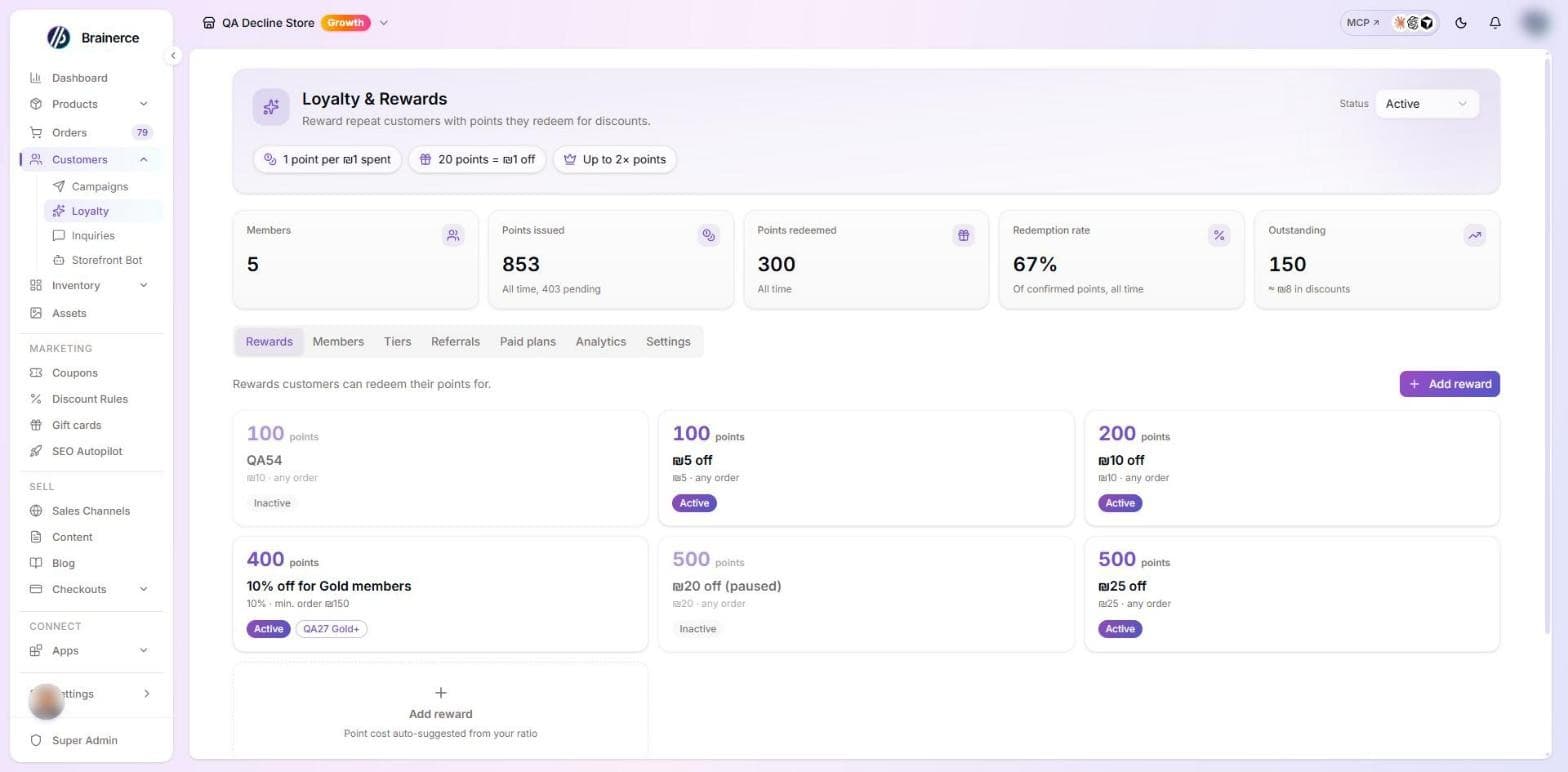
The Loyalty page opens with a program header (status control + your earn/redeem rates) and a KPI band: members, points issued, points redeemed, redemption rate, and outstanding points with their approximate value in discounts.
How the numbers are counted. The KPI band covers all time and the Analytics tab covers the period you pick (30 days, 90 days or a year), but both use the same definitions. Points issued is every credit to members: points earned from orders, bonuses and referrals, plus points you grant by hand with Adjust points. Points still in the pending window count as issued and are shown as pending. Points redeemed is what members spent on rewards. Redemption rate is points redeemed divided by issued points that are no longer pending, because pending points cannot be spent yet. Outstanding is the current balance members hold.
Below the KPI band, seven tabs:
| Tab | What you do there |
|---|---|
| Rewards | The catalog customers redeem points for. Create, edit, deactivate. |
| Members | Every enrolled customer: balance, tier, full points ledger, manual adjustments. |
| Tiers | The VIP ladder: levels, earn multipliers, qualification thresholds. |
| Referrals | The referral funnel and every referral, including fraud flags and manual rejection. |
| Paid plans | A recurring paid membership with a points multiplier that stacks on earned tiers. |
| Analytics | Points issued and redeemed over time, members by tier, and your most-redeemed rewards. |
| Settings | The whole program configuration: economics, bonuses, referrals, birthdays. |
In this section
- Points & rewards covers the earning economics, the pending window, and building your reward catalog.
- VIP tiers reward your best customers with faster earning.
- Engagement bonuses give points for joining, reviewing, and sharing.
- Referral program covers share codes, friend rewards, and the fraud-review queue.
- Birthday gifts send an automatic gift coupon ahead of each customer's birthday.
Paid plans, Analytics and Milestone badges
Paid plans
A recurring paid membership. Customers pay a fee on a billing cycle you set, and get a points multiplier that stacks on top of whatever tier they've earned. Subscriptions are charged automatically against saved cards. It has its own tab on the Loyalty page.
Add plan asks for:
| Field | Rule |
|---|---|
| Name | Required, up to 80 characters. |
| Price | In your store's currency, at least 0.5, in steps of 0.5. The form refuses a lower price. |
| Billing interval (days) | How often the customer is charged, from 1 to 365. 30 is monthly. |
| Points multiplier | From 1 to 20, in steps of 0.1. It multiplies earning on top of the member's tier multiplier while subscribed. |
| Perks description | Up to 500 characters, shown to customers on the storefront. |
| Active | Off stops new subscribers. Existing subscribers are billed until their period ends. |
Each plan card shows its price, interval, multiplier and N active subscribers. Delete plan removes a plan with no subscribers and no billing history. A plan that has either is deactivated instead, and its current subscribers stop being billed at the end of their period.
Analytics
Points issued and redeemed over time, members by tier, the referral funnel, and your most-redeemed rewards, over 30, 90 or 365 days. This is where you find out whether the programme costs what you assumed. It has its own tab on the Loyalty page.
Milestone badges
Display-only awards earned at thresholds of order count, lifetime spend, referrals, or reviews. They carry no discount; they exist to be shown off.
Badges are not a tab. They live at the bottom of the Rewards tab, which is where people go looking for them and don't find them.
Press Add badge and fill in:
- Name (up to 80 characters), for example "Loyal shopper".
- Milestone: Orders placed, Lifetime spend, Completed referrals or Reviews written.
- Threshold: the number (or the amount, for lifetime spend) at which the badge is awarded. It must be at least 1.
- Description (optional, up to 280 characters) and Icon URL (optional, a full web address of an image; empty uses the default medal).
A badge is awarded automatically, once per customer, when the customer reaches the threshold, and each badge shows how many times it has been awarded. It does not email the customer and carries no discount, so a customer sees it only if your storefront displays badges. You need a loyalty program before you can add one. Delete badge removes a badge nobody has earned. If customers already earned it, it is deactivated instead so their trophies stay, and it shows as inactive.
The embeddable widget
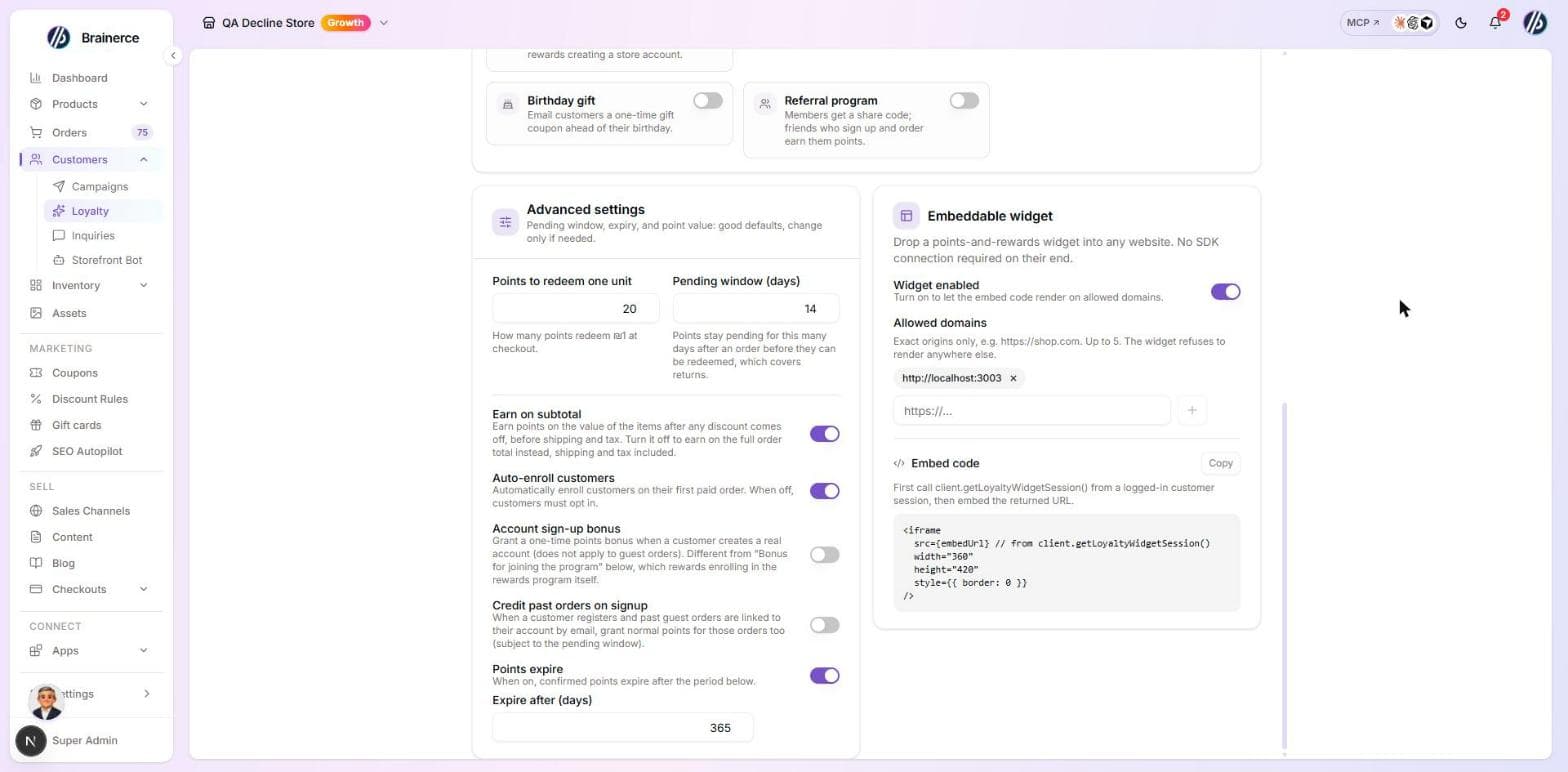
The Embeddable widget card at the bottom of Settings, beside Advanced settings, is a drop-in loyalty widget you can embed on any site. It shows a customer their points and lets them redeem, without you building that UI. Switch on Widget enabled, give it up to five Allowed domains (exact origins such as https://shop.com; a wildcard is refused, a path or default port is dropped when saved, and http:// is accepted only for localhost; the widget refuses to render anywhere else) and copy the Embed code. The dashboard has no colour settings for the widget: its three colours (primary, text and background, each a hex value) can be set only through a connected AI assistant.
What a customer sees: their points balance on top, then the rewards list, then My coupons. A reward they cannot afford yet is greyed out and shows how many points are missing.
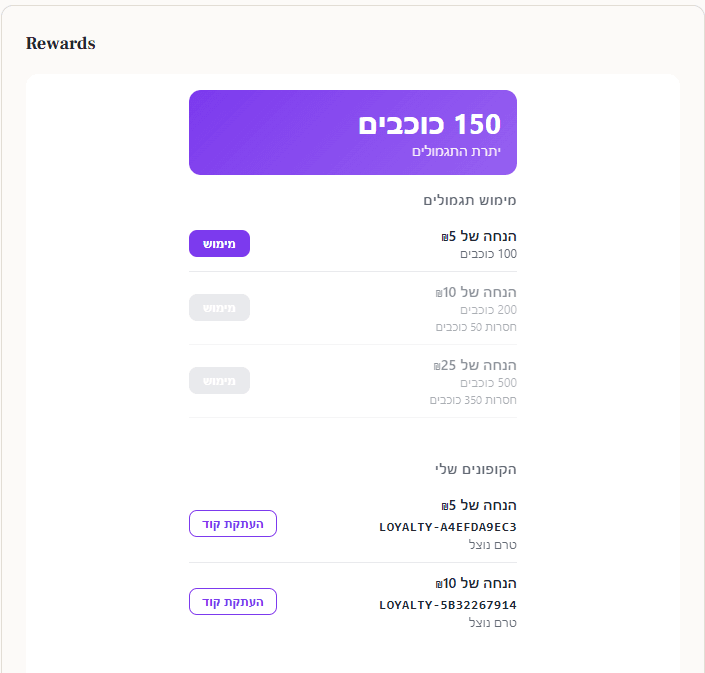
The widget speaks Hebrew with right-to-left layout when your store's language is Hebrew, and English for every other store language. After a customer redeems a reward, the widget updates their points balance and keeps the coupon code on screen with a Copy code button. My coupons lists the customer's most recent codes (up to 10) with Not used yet or Used, so a code is not lost when the page is reloaded; the customer enters the code at checkout. A code that is no longer valid shows No longer valid and has no copy button.
If Widget enabled is off, the widget is not available and the storefront's session call is refused. A store scaffolded with npx create-brainerce-store then shows its own built-in loyalty panel instead, so customers still see their points and rewards. Turn the widget on only if you want the hosted version.
It still needs one SDK call from your storefront to open a session, so it reduces the integration work rather than removing it.
Storefront requirement
Loyalty needs no integration to start earning points, but the customer-facing screens do. Purchase points accrue on orders placed through your storefront's checkout. Orders you create by hand with Create Order in the dashboard earn points only when you tick Award loyalty points for this order (see Orders you key in by hand earn points only if you tick the box); for anything else, use a manual points adjustment on the customer. The customer-facing surfaces (points balance, redeeming rewards, referral share links) need your storefront to integrate the loyalty SDK methods. Send your developer to the integration guide.